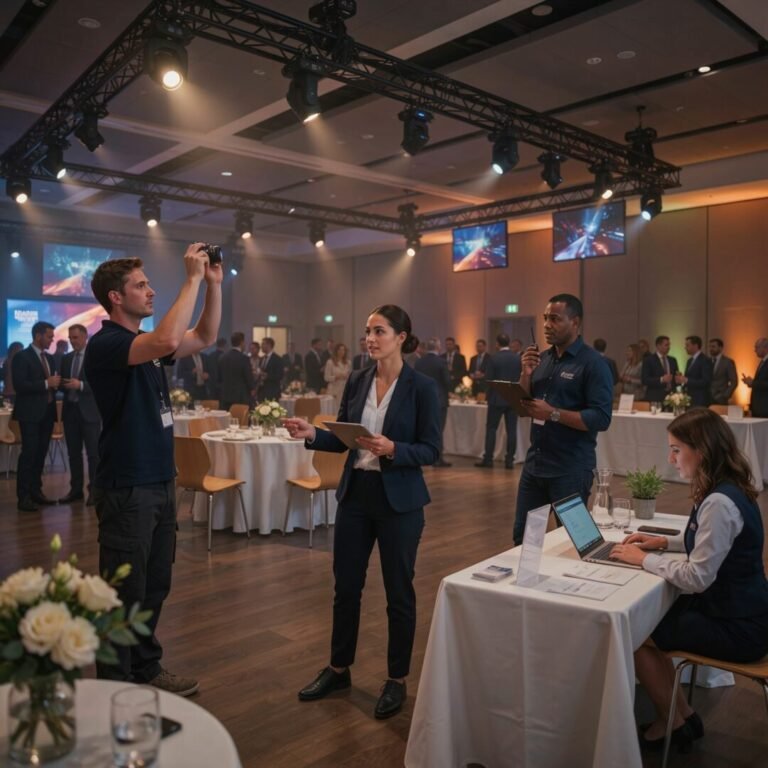
Executive Programme in AI-Driven Event Business Management
The Executive Programme in AI-Driven Event Business Management is a 100% online advanced professional certificate programme (1,500 hours, 12 months) for anyone who wants to build a career in ai-driven event business management. You learn through practical modules and real case studies, guided by tutors with industry experience, and finish with a capstone project.
New intake every two months · Interest-free payment plans · ESINEV certificate of completion (non-accredited training).

Overview
The Advanced Professional Certificate in AI-Driven Event Business Management prepares you to work with confidence on projects related to AI-Driven Event Business Management. You will learn to:
- Analyse needs, risks and opportunities.
- Design realistic solutions, plans and procedures.
- Coordinate teams, vendors and resources.
- Define KPIs to measure and improve results.
Studying from Australia
This programme is delivered 100% online in English, so you can study from anywhere in Australia — Sydney, Melbourne, Brisbane, Perth, Adelaide or Auckland — and fit your learning around work. The skills covered apply directly to events across Australia, from conferences and exhibitions to weddings and festivals. Fees are shown in Australian dollars (AUD) and can be spread with interest-free instalments.
About your certificate
ESINEV programmes are non-degree professional training delivered 100% online. On completion you receive an ESINEV certificate of completion. ESINEV is a private online training provider: this programme is not an Australian degree or AQF qualification, and is not accredited by TEQSA or ASQA.
Your learning path
Curriculum
A 1,500-hour program structured in 10 modules on managing event companies with artificial intelligence. It combines strategy, finance, operations and people with data, automation and generative AI to make better decisions and create new services.
Submodule 1.1. The events industry and AI
Analyze how artificial intelligence is transforming event agencies, venues and production companies.
Submodule 1.2. The AI-augmented value chain
Identify activities where AI improves productivity, quality or customer experience.
Submodule 1.3. Strategic analysis of the environment
Apply external analysis tools while taking the impact of technology into account.
Submodule 1.4. Data-driven competitive advantage
Define how proprietary data can differentiate an event company.
Submodule 1.5. AI-enabled business models
Explore new services based on personalization, prediction and automation.
Submodule 1.6. AI adoption roadmap
Prioritize use cases by value, technical feasibility and risk.
Submodule 1.7. Build, buy or partner
Decide between in-house development, commercial solutions or technology partnerships.
Submodule 1.8. Governing the technology strategy
Set up owners, committees and budgets for digital transformation.
Submodule 1.9. Strategic indicators
Design a scorecard that links AI initiatives to business results.
Submodule 1.10. The local technology ecosystem
Examine suppliers, talent and public support for innovation in your country.
Submodule 2.1. Key AI concepts
Distinguish machine learning, deep learning and generative AI with industry examples.
Submodule 2.2. Types of data in events
Identify registration, attendance, interaction, sales and operations data.
Submodule 2.3. Data quality and governance
Set rules for the capture, cleansing, ownership and use of data.
Submodule 2.4. Data architecture for mid-sized companies
Design a basic structure to integrate scattered information sources.
Submodule 2.5. Predictive models
Understand how models are trained and evaluated to forecast attendance or demand.
Submodule 2.6. Language models
Explain the capabilities and limitations of language models in business tasks.
Submodule 2.7. Prompt engineering
Write effective prompts to get useful results from generative tools.
Submodule 2.8. Evaluating AI outputs
Check the accuracy, bias and consistency of model-generated answers.
Submodule 2.9. No-code tools
Use visual platforms to automate tasks without programming.
Submodule 2.10. AI literacy for executives
Develop the judgment to engage with technical teams and specialist suppliers.
Submodule 3.1. Financial statements for executives
Interpret the balance sheet, income statement and cash flows of an event company.
Submodule 3.2. Profitability by project
Measure the real margins of each event and detect significant variances.
Submodule 3.3. Data-driven revenue forecasting
Use historical data and predictive models to anticipate sales and occupancy.
Submodule 3.4. Dynamic pricing
Apply variable pricing strategies to tickets, sponsorships and services.
Submodule 3.5. Budgets and management control
Prepare budgets and analyze variances with automated dashboards.
Submodule 3.6. Treasury management
Plan liquidity taking into account advances, seasonality and collection periods.
Submodule 3.7. Evaluating technology investments
Calculate the return, total cost and risks of AI projects.
Submodule 3.8. Financing innovation
Identify public funds, private capital and partnerships to finance projects.
Submodule 3.9. Financial risk and cancellations
Manage exposure to cancellations, non-payment and exchange rate fluctuations.
Submodule 3.10. Financial dashboards
Design visualizations that summarize the financial position for management.
Submodule 4.1. Advanced audience segmentation
Group clients and attendees by behavior, interests and value.
Submodule 4.2. Personalized communications
Automatically tailor messages, offers and content to each segment.
Submodule 4.3. AI-generated content
Produce supporting text, images and videos with human editorial oversight.
Submodule 4.4. Data-driven digital marketing
Optimize campaigns with conversion analysis and results attribution.
Submodule 4.5. Conversational assistants
Deploy chatbots to handle inquiries, registrations and support.
Submodule 4.6. Session and contact recommendations
Suggest personalized agendas and networking based on attendee profiles.
Submodule 4.7. AI-assisted B2B sales
Prioritize opportunities and prepare proposals with the help of smart tools.
Submodule 4.8. Data-driven sponsor management
Provide sponsors with metrics on exposure, engagement and lead generation.
Submodule 4.9. Sentiment and reputation analysis
Analyze comments and surveys to identify perceptions and areas for improvement.
Submodule 4.10. Measuring the attendee experience
Integrate satisfaction, participation and recommendation indicators into a single dashboard.
Submodule 5.1. Event project management
Apply planning and tracking methodologies to complex productions.
Submodule 5.2. Process automation
Identify repetitive tasks and automate them to free up the team's time.
Submodule 5.3. Assisted resource planning
Allocate staff, spaces and suppliers with optimization tools.
Submodule 5.4. Predicting attendance and flows
Anticipate turnout and crowd movements to size services.
Submodule 5.5. Logistics and supply chain
Optimize purchasing, transport and setups with data and forecasts.
Submodule 5.6. Accreditation and access control
Implement fast, secure digital registration and access systems.
Submodule 5.7. Real-time incident management
Use dashboards and alerts to detect and resolve problems during the event.
Submodule 5.8. Supplier management
Evaluate supplier performance with objective indicators and digital records.
Submodule 5.9. Quality and continuous improvement
Analyze operational data to improve processes event after event.
Submodule 5.10. Operational sustainability
Reduce waste, energy and emissions with data-driven measurement and planning.
Submodule 6.1. Organizational design with AI
Redefine roles and processes to integrate smart tools into daily work.
Submodule 6.2. New professional skills
Identify the digital and analytical skills teams need.
Submodule 6.3. Attracting and selecting talent
Design fair, transparent recruitment processes with human oversight.
Submodule 6.4. Training and reskilling
Plan training programs for the adoption of new tools.
Submodule 6.5. Leadership in changing environments
Guide teams through transformation with clear communication and participation.
Submodule 6.6. Performance management
Set objectives and appraisals consistent with new ways of working.
Submodule 6.7. Human-machine collaboration
Define which decisions remain in human hands and which are automated.
Submodule 6.8. Wellbeing and workload
Prevent burnout in teams facing activity peaks.
Submodule 6.9. Data culture
Promote evidence-based decision-making at every level of the company.
Submodule 6.10. Internal communication
Ensure smooth information flows between departments, projects and management.
Submodule 7.1. Ethical principles of AI
Apply criteria of transparency, fairness, accountability and human oversight.
Submodule 7.2. Personal data protection
Comply with privacy regulations when processing attendee data.
Submodule 7.3. AI regulatory frameworks
Review international and national regulations on artificial intelligence systems.
Submodule 7.4. Algorithmic bias and discrimination
Detect and mitigate bias in models that affect people.
Submodule 7.5. Facial recognition and biometrics
Assess the legal and ethical risks of using biometrics at events.
Submodule 7.6. Intellectual property and generated content
Analyze rights over content created with generative tools.
Submodule 7.7. Information security
Protect systems and data against unauthorized access and leaks.
Submodule 7.8. Contracting AI suppliers
Set clauses on data use, liability and auditing.
Submodule 7.9. Technology risk management
Identify operational and reputational risks arising from the use of AI.
Submodule 7.10. Internal AI use policy
Write clear rules for responsible use by employees and collaborators.
Submodule 8.1. Innovation management
Organize processes to generate and evaluate ideas for new services.
Submodule 8.2. Designing immersive experiences
Combine augmented reality, virtual reality and interactive content at events.
Submodule 8.3. Hybrid and virtual events
Develop formats that bring together in-person and remote audiences with added value.
Submodule 8.4. Data products for clients
Create reports and analytics services as a new revenue stream.
Submodule 8.5. Rapid prototyping
Validate new proposals with low-cost tests and fast learning.
Submodule 8.6. Partnerships with technology companies
Establish collaborations with startups and technology suppliers.
Submodule 8.7. Subscription and community models
Explore recurring revenue beyond the one-off event.
Submodule 8.8. Scaling formats
Design event formats that can be replicated in different cities and countries.
Submodule 8.9. Technology watch
Follow trends and developments to anticipate business opportunities.
Submodule 8.10. Evaluating the impact of innovation
Measure the results of new initiatives with business indicators.
Submodule 9.1. Digital maturity assessment
Assess the company's starting point in data, processes and technology.
Submodule 9.2. AI project portfolio
Select and prioritize initiatives using value and risk criteria.
Submodule 9.3. Pilots and scaling
Design pilot tests and criteria for rolling out solutions across the company.
Submodule 9.4. Managing technology suppliers
Select, contract and supervise implementation partners.
Submodule 9.5. Systems integration
Connect registration, CRM, finance and operations tools.
Submodule 9.6. Managing resistance to change
Address fears and objections through participation and training.
Submodule 9.7. Communicating change
Explain objectives, progress and benefits to teams and clients.
Submodule 9.8. Measuring the return on transformation
Assess time savings, additional revenue and quality improvement.
Submodule 9.9. Project governance
Set up committees, milestones and tracking mechanisms for the transformation.
Submodule 9.10. Lessons from real cases
Analyze AI implementations at event companies and related industries.
Submodule 10.1. The role of the CEO
Analyze the responsibilities and decisions of the company's top executive.
Submodule 10.2. Data-driven decision-making
Combine quantitative analysis and executive judgment in complex decisions.
Submodule 10.3. Strategic negotiation
Prepare negotiations with key clients, partners and investors.
Submodule 10.4. Internationalization
Evaluate foreign markets and entry modes for the company.
Submodule 10.5. Corporate governance
Establish governance, control and accountability bodies.
Submodule 10.6. Executive communication
Develop presentation skills for teams, clients and investors.
Submodule 10.7. Business plan structure
Integrate strategy, operations, marketing, people, technology and finance.
Submodule 10.8. Financial projections for the plan
Prepare forecasts of revenue, costs, investment and profitability.
Submodule 10.9. Pitching to investors
Communicate the project with clear arguments and verifiable data.
Submodule 10.10. Event company management cases
Study the strategic decisions of leading companies in the industry.
Design of a business plan for an event company that incorporates artificial intelligence, including diagnosis, prioritized use cases, operating model, change management, ethical framework and financial projections.
Career paths
This program strengthens your profile for roles related to AI-Driven Event Business Management: project coordination, operations, consulting and specialised event services at agencies, venues, hotels and corporate event teams.
Admissions
- Request information
Leave your details and an adviser will contact you.
- Guidance call
We review your profile and career goals.
- Enrolment and access
Secure your place and get access to the campus.
Fees & payment
Indicative instalment. Please confirm payment terms with the admissions team.
Frequently asked questions
Is this an official degree?
On completion you receive an ESINEV certificate. It is not an official degree; recognition can be assessed depending on the programme you complete and local regulations.
How long is it and how many hours?
Duration: 12 months. Study load: 1,500 hours, designed to fit around your work.
Is it taught online?
Yes. It is 100% online, with a virtual campus, downloadable materials and tutoring from industry professionals.
Can I pay in instalments?
Yes. Payment: Up to 12 monthly payments. The admissions team will confirm the terms.
When can I start?
Classes start exactly one month after you enrol: if you enrol today, you start on 28 December 2026. Enrolment is open all year and closes every Friday.
Shall we talk about your future in events?
Leave your details and an adviser will walk you through the programme, dates and payment options.
WhatsApp