Professional Certificate in Crowd Flow Modelling and Simulation
The Professional Certificate in Crowd Flow Modelling and Simulation is a 100% online professional certificate (450 hours, 36 weeks) for anyone who wants to build a career in crowd flow modelling and simulation. You learn through practical modules and real case studies, guided by tutors with industry experience, and finish with a final project.
New intake every two months · Interest-free payment plans · ESINEV certificate of completion (non-accredited training).

Overview
The Professional Certificate in Crowd Flow Modelling and Simulation prepares you to work with confidence on projects related to Crowd Flow Modelling and Simulation. You will learn to:
- Analyse needs, risks and opportunities.
- Design realistic solutions, plans and procedures.
- Coordinate teams, vendors and resources.
- Define KPIs to measure and improve results.
Studying from Australia
This programme is delivered 100% online in English, so you can study from anywhere in Australia — Sydney, Melbourne, Brisbane, Perth, Adelaide or Auckland — and fit your learning around work. The skills covered apply directly to events across Australia, from conferences and exhibitions to weddings and festivals. Fees are shown in Australian dollars (AUD) and can be spread with interest-free instalments.
About your certificate
ESINEV programmes are non-degree professional training delivered 100% online. On completion you receive an ESINEV certificate of completion. ESINEV is a private online training provider: this programme is not an Australian degree or AQF qualification, and is not accredited by TEQSA or ASQA.
Your learning path
Curriculum
A 450-hour program in 8 modules to model, simulate and manage crowd movement at events with safety and experience criteria.
Submodule 1.1. Crowd dynamics
Understand collective behavior, densities and flow transitions at events.
Submodule 1.2. Density, speed and flow rate
Relate density, walking speed and flow rate using the fundamental diagram.
Submodule 1.3. Fruin levels of service
Apply pedestrian levels of service to size spaces.
Submodule 1.4. Crowd psychology
Analyze risk perception, decision-making and collective social behavior.
Submodule 1.5. Analysis of historical incidents
Draw lessons from documented crowd crush incidents at events.
Submodule 1.6. The DIM-ICE model
Use the DIM-ICE model to analyze design, information and management.
Submodule 1.7. Terminology and units
Master the technical terms and units used in crowd flow studies.
Submodule 2.1. Capacity and safe capacity
Calculate capacity based on usable area, exits and applicable regulations.
Submodule 2.2. Manual and automatic counting
Combine manual counts, turnstiles and sensors to measure flows.
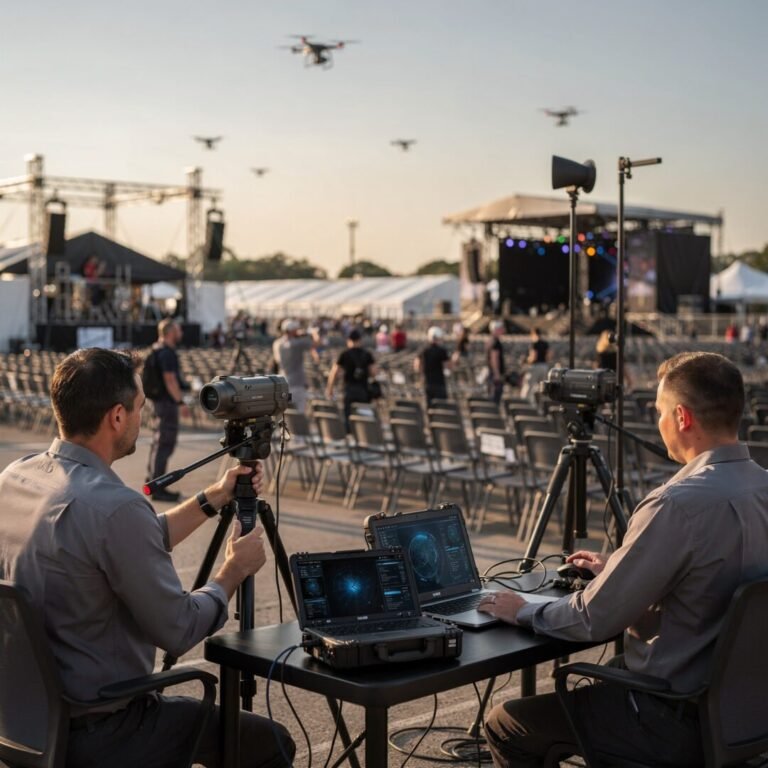
Submodule 2.3. Computer vision and cameras
Use video analysis to estimate densities and directions of movement.
Submodule 2.4. Ticketing and access data
Use ticket validation data to profile arrivals.
Submodule 2.5. Wi-Fi, Bluetooth and mobile signals
Estimate movements with aggregated device data while respecting privacy.
Submodule 2.6. Arrival and departure curves
Build time profiles of audience arrival, dwell and departure.
Submodule 2.7. Data cleaning and quality
Clean flow data and handle gaps and measurement errors.
Submodule 3.1. Types of models
Distinguish macroscopic, mesoscopic and agent-based models.
Submodule 3.2. The social force model
Understand the social force model and its key parameters.
Submodule 3.3. Cellular automata
Apply cellular automata models to simple evacuation scenarios.
Submodule 3.4. Queuing theory
Model queues at entrances, bars and restrooms to size services.
Submodule 3.5. Parameter calibration
Fit walking speeds, body sizes and behaviors to real data.
Submodule 3.6. Model validation
Compare simulated results with observations to validate the model.
Submodule 3.7. Limitations and uncertainty
Recognize the limits of models and communicate the uncertainty of results.
Submodule 4.1. Software overview
Compare commercial and open-source pedestrian simulation tools.
Submodule 4.2. Building the scenario
Import CAD drawings and define geometries, obstacles and zones.
Submodule 4.3. Defining populations
Configure audience profiles, routes and destinations in the simulation.
Submodule 4.4. Evacuation scenarios
Simulate evacuations with blocked exits and pre-movement times.
Submodule 4.5. Heat maps and density maps
Interpret cumulative density maps and hotspots.
Submodule 4.6. Venue digital twins
Integrate the simulation into digital models of the venue.
Submodule 4.7. Flow spreadsheets
Carry out quick flow rate and time calculations without specialist software.
Submodule 5.1. Sizing doors and corridors
Calculate exit widths based on specific flow and target time.
Submodule 5.2. Designing queues and switchbacks
Design queues with appropriate fencing, signage and capacity.
Submodule 5.3. Front-of-stage areas
Configure pits, barriers and access aisles in front of stages.
Submodule 5.4. Entry and security screening
Size metal detector arches, bag searches and ticket validation to avoid bottlenecks.
Submodule 5.5. Circulation between zones
Plan one-way routes and the separation of opposing flows.
Submodule 5.6. Signage and wayfinding
Use signage to distribute flows and reduce decision-making at junctions.
Submodule 5.7. Accessibility in crowd flows
Integrate accessible routes and refuge areas for people with reduced mobility.
Submodule 6.1. Crowd control room
Organize the control room with cameras, data and communications.
Submodule 6.2. Thresholds and alerts
Define density thresholds and tiered response protocols.
Submodule 6.3. Dynamic management measures
Apply temporary closures, diversions and controlled holding of the audience.
Submodule 6.4. Communicating with the audience
Issue messages via PA, screens and the app to guide movement.
Submodule 6.5. Coordination with security and emergency services
Coordinate actions with private security, police and medical services.
Submodule 6.6. Staggered exits and transport
Manage coordinated egress with public transport and parking.
Submodule 6.7. Incident logging
Document incidents and decisions for later analysis.
Submodule 7.1. Public entertainment regulatory framework
Apply public entertainment and emergency planning regulations to crowd flow management.
Submodule 7.2. Emergency plan
Integrate crowd flow studies into the event's emergency plan.
Submodule 7.3. Crowd risk assessment
Identify and assess crowding risks using structured matrices.
Submodule 7.4. International reference guidance
Consult internationally recognized crowd safety guidance.
Submodule 7.5. Privacy in monitoring
Comply with data protection legislation when using cameras and device data.
Submodule 7.6. Technical simulation report
Write reports with clear assumptions, results and recommendations.
Submodule 7.7. Communicating with authorities
Present crowd flow studies to public authorities to obtain permits.
Submodule 8.1. Case and scope
Select an event and define the scope of the crowd flow study.
Submodule 8.2. Collecting baseline data
Gather plans, capacities, schedules and audience profiles.
Submodule 8.3. Modeling the scenario
Build the venue model with entrances and critical zones.
Submodule 8.4. Simulating scenarios
Simulate arrival, dwell, departure and emergency evacuation.
Submodule 8.5. Improvement proposals
Propose design and operational changes based on the results.
Submodule 8.6. Crowd operations plan
Write thresholds, roles and protocols for live management.
Submodule 8.7. Defending the study
Present the technical report and justify the decisions made.
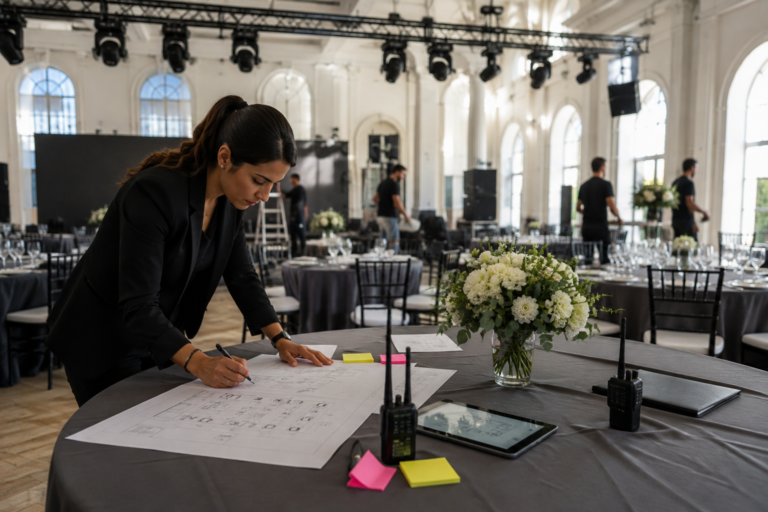
Prepare a crowd flow study for a real event with scenario simulation, design proposals and an operational crowd management plan.
Career paths
This program strengthens your profile for roles related to Crowd Flow Modelling and Simulation: project coordination, operations, consulting and specialised event services at agencies, venues, hotels and corporate event teams.
Admissions
- Request information
Leave your details and an adviser will contact you.
- Guidance call
We review your profile and career goals.
- Enrolment and access
Secure your place and get access to the campus.
Fees & payment
Indicative instalment. Please confirm payment terms with the admissions team.
Frequently asked questions
Is this an official degree?
On completion you receive an ESINEV certificate. It is not an official degree; recognition can be assessed depending on the programme you complete and local regulations.
How long is it and how many hours?
Duration: 36 weeks. Study load: 450 hours, designed to fit around your work.
Is it taught online?
Yes. It is 100% online, with a virtual campus, downloadable materials and tutoring from industry professionals.
Can I pay in instalments?
Yes. Payment: Up to 10 monthly payments. The admissions team will confirm the terms.
When can I start?
Classes start exactly one month after you enrol: if you enrol today, you start on 26 December 2026. Enrolment is open all year and closes every Friday.
Shall we talk about your future in events?
Leave your details and an adviser will walk you through the programme, dates and payment options.
WhatsApp